.png)
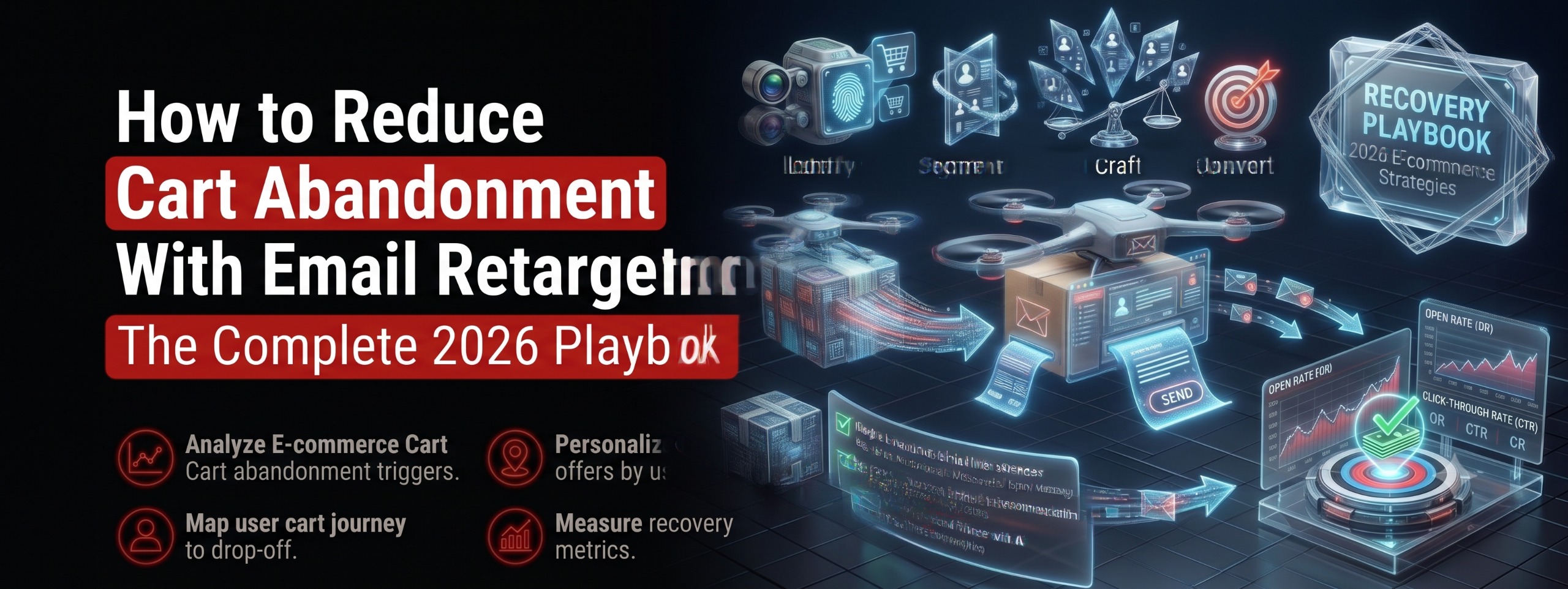
How to Reduce Cart Abandonment With Email Retargeting: The Complete 2026 Playbook
Every online store loses money to the same silent problem: shoppers who add products to their cart, get within one click of buying, and then vanish. They get distracted, they balk at the shipping cost, they decide to "think about it" — and most of them never come back on their own.
The good news is that an abandoned cart is not a lost sale. It is a paused one. And the single most reliable, highest-ROI way to restart it is email retargeting — automated, behavior-triggered emails that bring hesitant shoppers back to finish what they started.
In this guide, we break down exactly how to reduce cart abandonment with email retargeting: why people abandon carts in the first place, how retargeting emails work, the timing and sequence that actually recovers revenue, and the templates, tactics, and metrics that separate top-performing stores from everyone else. Whether you run a boutique Shopify brand or a multi-market e-commerce operation, this playbook is built to be put to work today.
What Is Cart Abandonment (and Why It's Quietly Draining Your Revenue)
Cart abandonment happens when a shopper adds one or more items to their online cart but leaves without completing the purchase. It is one of the most closely watched metrics in e-commerce — and one of the most stubborn.
According to the Baymard Institute, which aggregates data from roughly 50 separate studies, the global average cart abandonment rate sits at about 70%. In other words, for every ten shoppers who fill a cart, only about three check out. On mobile devices the picture is even worse, with abandonment rates climbing toward 85% as small screens, fiddly forms, and distraction take their toll.
Put in revenue terms, that is staggering. Baymard estimates that better checkout flows alone could help large e-commerce sites recover hundreds of billions of dollars in otherwise-lost orders every year. For your store specifically, the math is simple: if you are doing $100,000 a month in revenue at a 70% abandonment rate, there is a very large pool of high-intent buyers walking away — and a well-built email retargeting program can recover a meaningful slice of it, often 20–30% of that otherwise-lost revenue.
The key insight is this: a shopper who builds a cart has already done the hard part. They found you, they evaluated a product, and they signalled clear purchase intent. That makes them dramatically more valuable — and more recoverable — than cold traffic. Email retargeting exists to convert that intent before it cools.
Why Shoppers Abandon Their Carts
You cannot fix a problem you do not understand. Before you write a single retargeting email, it helps to know why people leave. Most abandonment falls into a handful of predictable buckets:
- Unexpected extra costs. This is the number-one reason, cited by roughly half of all abandoners. Shipping fees, taxes, and surcharges that only appear at checkout shatter trust and kill momentum.
- Being forced to create an account. Many shoppers abandon rather than fill out a registration form just to buy one item.
- A long, complicated, or confusing checkout. Every extra field and every extra step bleeds conversions.
- Payment security concerns. If the checkout looks dated or untrustworthy, shoppers hesitate to enter card details.
- Comparison shopping and "saving for later." A large share of people use the cart as a wish list or a way to see the final price, fully intending to return.
- Limited payment or delivery options. No preferred payment method, or delivery that is too slow or too expensive.
- Distraction and friction. A phone call, a crying child, a slow-loading page — sometimes life simply interrupts.
Here is the encouraging part: almost none of these are dead ends. A shopper comparing prices can be won with a timely reminder. A distracted buyer just needs a nudge. Someone spooked by shipping costs might convert with free shipping or a small incentive. Email retargeting is the mechanism that meets each of these objections at exactly the right moment.
What Is Email Retargeting — and Why It Works So Well
Email retargeting is the practice of automatically sending targeted emails to shoppers based on the actions they took (or didn't take) on your site. Instead of blasting your whole list, you trigger a relevant message to a specific person because of specific behavior.
In an e-commerce context, email retargeting usually covers three intent levels:
- Browse abandonment — someone viewed products but never added to cart.
- Cart abandonment — someone added items to the cart but didn't reach checkout.
- Checkout abandonment — someone started checkout (often entering their email) but didn't pay. This is the hottest, highest-intent group of all.
Why is email such a powerful retargeting channel? A few reasons:
- It reaches high-intent people. Cart and checkout abandoners have already shown they want to buy.
- It's an owned channel. Unlike paid ads, you don't pay per impression or fight an auction. Once someone is on your list, reaching them is essentially free.
- It's measurable and automatable. Set the flow up once and it recovers revenue around the clock.
- It converts. Abandoned cart emails are among the highest-performing messages in all of email marketing.
The numbers back this up. Recovery emails consistently earn open rates far above standard marketing emails — analyses of stores on platforms like Klaviyo show abandoned cart flows averaging around 50% open rates, with the first email in a sequence often opening above 60%. On the revenue side, abandoned cart and welcome flows together can account for a huge share of all automated email revenue (Omnisend has reported figures around 76%), and well-run flows can drive several dollars in recovered revenue per recipient. The best-performing stores recover 10–14% of abandoned carts through email — several times the typical rate.
That is the prize. Now let's build the system that captures it.
How to Reduce Cart Abandonment With Email Retargeting: A Step-by-Step Playbook
This is the core of the guide. Follow these steps in order, and you will have a retargeting program that performs in the top tier of e-commerce stores.
1. Capture the email as early as possible
You cannot retarget someone you can't email. The single biggest lever on the size of your recovery program is how early you capture the shopper's email address.
- Ask for email at the first step of checkout, before payment details, so you capture it even if they bail.
- Use on-site sign-up incentives (a first-order discount, a welcome offer) to grow your list of known visitors.
- Deploy exit-intent capture for shoppers about to leave with items in their cart.
Every additional email captured expands the audience your retargeting flow can recover. This is foundational.
2. Set up triggers and tracking correctly
Email retargeting runs on accurate behavioral data. Your email platform (Klaviyo, Omnisend, Mailchimp, Braze, or similar) needs to know when a cart was created, what was in it, and when it was abandoned.
- Install your platform's tracking/pixel and connect it to your store.
- Define the abandonment trigger — typically, cart created + no purchase within a set window (e.g., 30–60 minutes).
- Make sure the flow can pull dynamic cart contents (product names, images, prices) into the email. Showing the actual abandoned items dramatically lifts conversions.
3. Build a sequence, not a single email
This is the mistake that costs stores the most: sending one lonely reminder and calling it a day. A multi-email sequence consistently and dramatically outperforms a single send.
The data is unambiguous. Klaviyo's analysis found that three-email abandoned cart sequences generated roughly 6.5x more revenue than single-email setups ($24.9M versus $3.8M across the stores studied). Each additional email recaptures a slice of abandoners the previous one missed — and even the third email in a series still earns open rates in the mid-40% range.
A proven three-part structure looks like this:
- Email 1 — The Reminder. Friendly, helpful, no discount. "You left something behind." Show the cart, make returning effortless.
- Email 2 — The Nudge. Add value: address objections, highlight reviews and trust signals, answer "why buy now." Introduce light urgency.
- Email 3 — The Incentive. If they still haven't converted, this is where a discount, free shipping, or a "last chance" message earns its place.
4. Nail the timing
When you send matters as much as what you send. Intent decays fast, so speed wins — but spacing the sequence keeps you from feeling pushy.
A reliable cadence that mirrors best-practice benchmarks:
- Email 1: within 30–60 minutes of abandonment. Sending the first reminder inside the first hour is consistently the most powerful single timing decision you can make.
- Email 2: around 24 hours later (industry analysis puts the average gap between the first and second email near 17–24 hours).
- Email 3: 48–72 hours after abandonment, before intent disappears entirely.
For higher-priced, higher-consideration products, you can stretch the windows slightly — buyers need more time to deliberate on a big purchase. For impulse or low-cost items, move faster. And if you add SMS to the mix, respect platform rules and quiet hours (many guidelines cap cart-abandonment SMS at one message within 48 hours).
5. Write subject lines that actually get opened
Your email can't convert if it isn't opened. Abandoned cart emails already enjoy high open rates because of intent — but strong subject lines push them higher.
- Keep it short, specific, and human: "Did you forget something?" / "Your cart is waiting."
- Personalize with the product or first name where it feels natural.
- Use urgency sparingly but deliberately — research shows more than 90% of abandoned cart subject lines lack any urgency, so phrases like "Last chance" or "Selling fast" help you stand out and lift opens.
- Hint at value (free shipping, a saved item) without giving everything away.
- A/B test relentlessly. Subject lines are the cheapest, fastest thing to optimize.
6. Design an email that converts
Once opened, the email needs to do one job: get the shopper back to checkout. The anatomy of a high-converting abandoned cart email:
- A clear, single call-to-action — one obvious button ("Return to your cart" / "Complete your order"). Don't bury it.
- The actual cart contents — product image, name, and price pulled in dynamically. People are reminded of what they wanted.
- Trust signals — reviews, ratings, return policy, secure-checkout badges, guarantees. These quietly dissolve hesitation.
- Clean, mobile-first design — most emails are opened on a phone. If the button is hard to tap, you lose the sale.
- Brand consistency — the email should look and feel like your store, not a generic template.
7. Personalize beyond the first name
Personalization is where good retargeting becomes great. Tailoring the message to the individual shopper can lift performance dramatically — personalized emails can drive a majority of email-generated revenue.
Go further than "Hi [Name]":
- Recommend complementary products based on what's in the cart.
- Reflect browsing history and previously viewed items.
- Adjust messaging by customer type — a first-time visitor needs reassurance; a loyal repeat buyer might respond better to a loyalty perk.
- Use cart value to decide the offer: research suggests incentives work especially well on mid-value carts.
8. Use incentives strategically — don't lead with discounts
It is tempting to open with "Here's 20% off!" Resist it. If you train shoppers to expect a discount every time they abandon, you erode your margins and teach people to abandon on purpose.
The smarter approach:
- Lead with a reminder and value, not a coupon.
- Reserve the discount for later in the sequence, for shoppers who didn't convert on reminders alone.
- For high-consideration purchases, story, social proof, and reassurance often outperform price cuts entirely.
- Track margin impact. Every discount comes straight out of profit, so measure recovered revenue net of the incentive cost.
9. Layer in urgency and social proof
Two psychological levers move hesitant buyers more than almost anything else:
- Urgency and scarcity — "Only a few left in stock," "Your cart expires soon," "Sale ends tonight." Used honestly, this overcomes procrastination.
- Social proof — star ratings, review counts, user-generated photos, and "bestseller" or "trending" tags reassure shoppers they're making a good choice.
10. Optimize for mobile
With mobile abandonment rates near 85%, the mobile experience isn't a detail — it's the battleground. Make sure your retargeting emails (and the checkout they link to) load fast, render cleanly on small screens, use large tappable buttons, and carry the shopper straight back to a pre-filled cart with as little friction as possible.
11. Go multi-channel: email + SMS + paid retargeting
Email is the foundation, but the highest-performing recovery programs surround the shopper across channels. Pairing your email sequence with SMS reminders and paid retargeting ads (on social and display) creates multiple touchpoints and meaningfully increases recovery. The shopper who ignores an email may tap an SMS; the one who ignores both may click a perfectly timed ad. This is also where the line blurs between email retargeting and broader performance marketing — and where an integrated strategy pays off most.
12. Segment your abandoners
Not all abandoned carts are equal. A $30 single-item cart and a $400 multi-item cart deserve different treatment. Segment by:
- Cart value (high vs. low AOV).
- Customer status (new vs. returning vs. VIP).
- Intent level (browse vs. cart vs. checkout abandonment).
- Product category (a luxury item needs different reassurance than a consumable).
Tailored flows for each segment recover more revenue than a one-size-fits-all blast.
13. Protect deliverability and stay compliant
None of this works if your emails land in spam. Recovery is fundamentally a deliverability game — the difference between average and elite revenue-per-recipient often comes down to whether emails reach the primary inbox.
- Authenticate your domain (SPF, DKIM, DMARC).
- Maintain good list hygiene and sender reputation.
- Honor unsubscribes instantly and respect consent rules (GDPR, CAN-SPAM, and local regulations in every market you sell to).
- Send to engaged, opted-in shoppers — never scraped or purchased lists.
14. Test, measure, and iterate
Email retargeting is never "set and forget." The top stores treat it as an ongoing optimization engine, continually testing subject lines, timing, offers, creative, and sequence length, and doubling down on what the data rewards.
The Metrics That Actually Matter
To know whether your email retargeting is working, track these KPIs:
- Recovery rate — the percentage of abandoned carts recovered. Typical programs land around 3–5%; top performers hit 10–14%.
- Revenue per recipient (RPR) — the north-star metric. It balances conversion against reach and keeps timing and offer decisions grounded in dollars.
- Open rate — how compelling your subject lines and sender reputation are.
- Click-through rate — how persuasive your email content and CTA are.
- Conversion rate — the share of recipients who complete the purchase.
- Return on investment — recovered revenue measured net of discounts and tooling costs.
Watch these over time, segment them, and let them guide every iteration.
Common Mistakes to Avoid
- Sending only one email. You're leaving the majority of recoverable revenue on the table.
- Waiting too long to send. Intent decays by the hour. Get the first email out fast.
- Leading with a discount every time. It trains abandonment and destroys margin.
- Ignoring mobile. Most opens are on phones; a clunky mobile experience kills conversions.
- Generic, untargeted messaging. No personalization, no segmentation, no cart contents.
- Neglecting deliverability. The best email in the world earns nothing from the spam folder.
- Never testing. What worked last quarter may not work now.
How ATNR Helps Brands Turn Abandoned Carts Into Revenue
Building an email retargeting program that performs in the top tier takes more than switching on a template. It takes strategy, sharp creative, technical setup, and continuous optimization working together — which is exactly where ATNR comes in.
ATNR is an award-winning digital marketing agency built on a simple promise: creative + performance. We've earned 7 Dragons at the Dragons of Asia Awards and 2 PAS Awards, and we partner with ambitious brands across Pakistan, the UAE, Saudi Arabia, and Oman — including names like Red Bull, Lipton, Kate Spade, Cole Haan, inDrive, and Krave Mart.
For e-commerce brands fighting cart abandonment, we bring together the exact capabilities a high-performing retargeting program needs:
- Performance Marketing — conversion-focused campaigns that turn intent into revenue, combining lifecycle email, paid retargeting, analytics, and relentless optimization.
- Conversion-driven digital experiences — we design and build fast, intuitive, mobile-first websites and checkouts engineered to reduce friction at the exact points where carts leak.
- Strategy & audience intelligence — segmentation, customer insight, and data-driven decisions that make every retargeting touchpoint relevant.
- Creative that converts — email design and copy, on-brand and built to move shoppers from "maybe later" to "order placed."
- Integrated, multi-channel media — pairing email retargeting with SMS and paid social/display so you surround high-intent shoppers everywhere they are.
In short: we don't just send recovery emails — we build the full revenue-recovery system around them, then optimize it until it performs.
Frequently Asked Questions
What is email retargeting in e-commerce?
Email retargeting is the practice of automatically sending targeted emails to shoppers based on their on-site behavior — most commonly to people who added items to their cart but didn't buy. The goal is to bring high-intent shoppers back to complete their purchase.
How much can email retargeting actually recover?
It varies, but well-run abandoned cart email programs commonly recover 20–30% of otherwise-lost revenue, with top-performing stores recovering 10–14% of abandoned carts. The exact figure depends on your timing, sequence, personalization, and deliverability.
How many abandoned cart emails should I send?
A three-email sequence is the proven standard. Single emails dramatically underperform — multi-email sequences have been shown to drive several times more recovered revenue.
When should I send the first abandoned cart email?
Within the first hour of abandonment (often 30–60 minutes). Sending fast, while intent is still high, is one of the most impactful decisions in the entire flow. Follow up around 24 hours later, then again at 48–72 hours.
Should I include a discount in abandoned cart emails?
Not in the first email. Lead with a helpful reminder and value, reserve discounts for later in the sequence (for shoppers who didn't convert otherwise), and always measure recovered revenue net of the discount cost.
What's the average cart abandonment rate?
The global average is roughly 70% across industries (and closer to 85% on mobile), based on the Baymard Institute's analysis of around 50 studies. Rates vary by industry, region, and device.
Is email retargeting better than paid retargeting ads?
They work best together. Email is the highest-ROI channel because it reaches high-intent shoppers through an owned channel at near-zero marginal cost — but pairing it with SMS and paid retargeting creates multiple touchpoints and recovers more revenue overall.
Key Takeaways
- Cart abandonment averages around 70% (and ~85% on mobile), but abandoned carts are paused sales, not lost ones.
- Email retargeting is the highest-ROI way to recover them — high intent, owned channel, low cost, highly measurable.
- Capture emails early, trigger flows accurately, and always send a sequence, not a single email.
- Send the first email within the first hour; follow up at ~24 hours and again at 48–72 hours.
- Lead with reminders and value; reserve discounts for later; layer in urgency, social proof, and personalization.
- Optimize for mobile, protect deliverability, segment your abandoners, and never stop testing.
- Track recovery rate and revenue per recipient as your north-star metrics.
Ready to Recover the Revenue You're Losing?
Every abandoned cart is money sitting on the table — and a well-built email retargeting program is the fastest way to get it back. If you want a partner to design, build, and optimize a recovery system that actually performs, ATNR is ready to help.
👉 Get in touch with ATNR to turn your abandoned carts into your next growth channel. Explore our expertise and our work to see what creative + performance can do for your brand.
Sources & Further Reading
- Baymard Institute — Cart Abandonment Rate Statistics (analysis of ~50 studies)
- Klaviyo — Abandoned cart flow benchmarks and revenue analysis
- Omnisend — Abandoned cart email report and automation revenue data
- Contentsquare / Analyzify — Abandoned cart email open, click, and conversion benchmarks
- Stripo, TargetBay, Swell — Abandoned cart email timing and best-practice studies
Statistics referenced reflect industry benchmarks reported in 2025–2026 and will vary by industry, region, and store. Use them as directional benchmarks, not guarantees.
