.png)
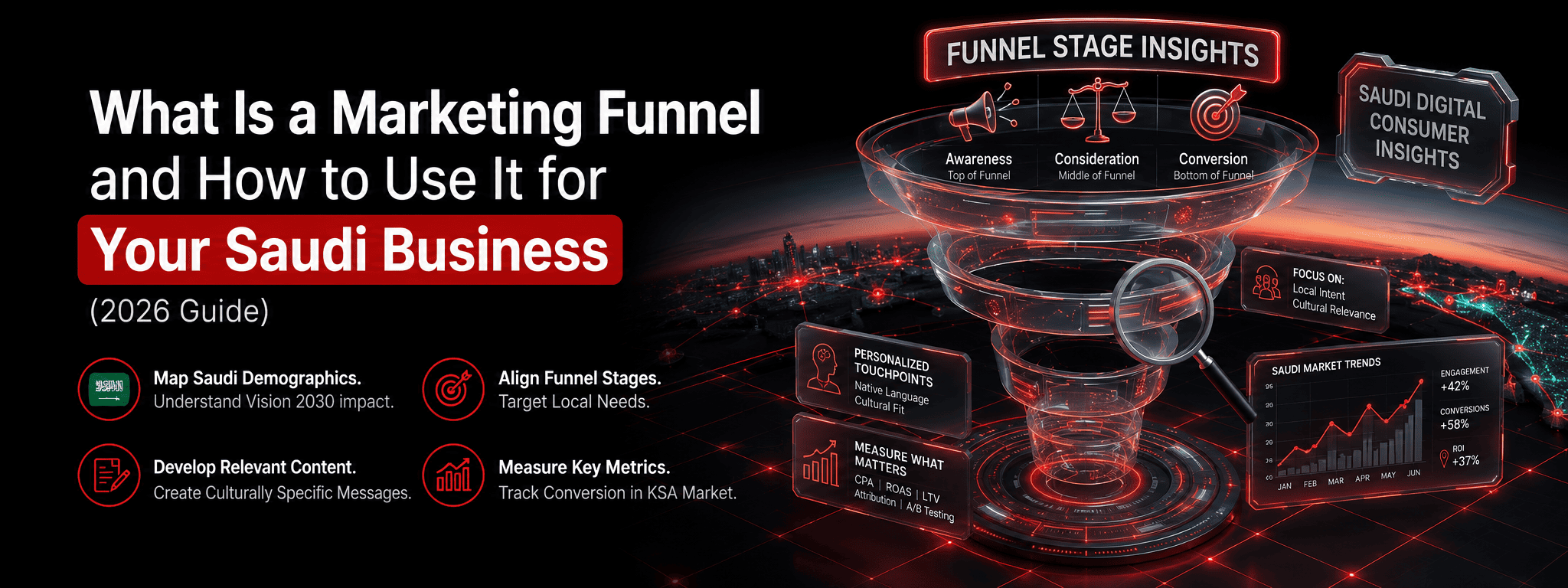
Most Saudi businesses are running half a marketing strategy without knowing it.
They invest in Snapchat ads to create awareness. They invest in a polished Instagram presence. They produce video content for YouTube. And then they wonder why — despite genuinely strong visibility — their sales are not growing in proportion to what they are spending on marketing.
The answer, almost always, is the same. They are great at the top. They have no middle. And they have not thought about the bottom at all.
This is the marketing funnel problem — and it is extraordinarily common across Saudi Arabia's business landscape, where between roughly 2021 and 2024, Vision 2030 momentum encouraged many organisations to invest heavily in awareness-led campaigns, sometimes with limited performance discipline. By 2025, organisations began to prioritise effectiveness, with pressure to demonstrate tangible impact through conversions, leads, or behavioral shifts rather than only reach and impressions.
A marketing funnel is the structured framework that solves this problem. It maps the complete journey a potential customer takes from the moment they first discover your brand to the moment they become a loyal customer who refers others. And it tells you exactly what to do — with what content, on which channel, at what moment — to guide more people through each stage of that journey.
This guide explains the marketing funnel in plain terms, applies every stage specifically to Saudi Arabia's market and consumer behavior, and gives you a practical blueprint for building a funnel that works for your business in 2026.
A marketing funnel is a model that represents the stages a potential customer moves through on their journey from discovering your brand to making a purchase — and ideally, to becoming a loyal customer who recommends you to others.
The word "funnel" describes the shape of the process. At the top, the opening is wide: a large number of people become aware of your business. As they move through the stages — from awareness to consideration to purchase — some drop off at each stage, and the number of people remaining narrows. At the bottom, a smaller but highly qualified group has become paying customers.
The standard marketing funnel has three core stages:
Top of Funnel (TOFU) — Awareness. The potential customer does not yet know your brand exists. Your job at this stage is to get in front of them with content and advertising that creates recognition and interest. The goal is not to sell — it is to be seen and remembered.
Middle of Funnel (MOFU) — Consideration. The potential customer now knows your brand and is actively evaluating whether you meet their needs. They are comparing options, reading reviews, watching demonstrations, and forming a preference. Your job at this stage is to provide the information, evidence, and reassurance that moves them toward choosing you over competitors.
Bottom of Funnel (BOFU) — Conversion. The potential customer is ready to act. They have done their research and they are making a decision. Your job at this stage is to make the conversion as easy and compelling as possible — through a strong offer, a frictionless process, and a final push that transforms intent into action.
Beyond these three core stages, modern marketing funnels extend further:
Retention. After conversion, the goal shifts to keeping the customer — encouraging repeat purchases, deepening engagement, and increasing the lifetime value of the relationship.
Advocacy. The highest stage. Satisfied customers become active promoters — recommending your business to their network, leaving reviews, sharing content. Advocacy is earned marketing at its most powerful.
Understanding the funnel is not an academic exercise. It is a practical diagnostic tool. When revenue growth stalls despite consistent marketing spend, identifying which stage of the funnel is underperforming tells you exactly what to fix.
Saudi Arabia's marketing environment in 2026 makes funnel thinking more valuable — and more necessary — than in most other markets.
Saudi businesses have always been strong at awareness. Outdoor advertising on King Fahad Road, Ramadan television campaigns, Snapchat playthroughs, YouTube pre-rolls — the Saudi market's high concentration of premium ad inventory and its digitally engaged population makes generating awareness relatively straightforward for any brand with adequate budget.
The problem is that awareness alone does not generate revenue. A potential customer who sees your brand on Snapchat, finds it interesting, and then gets no further touchpoint — no content to deepen interest, no retargeting to maintain presence, no clear path to purchase — has been exposed to your marketing cost without converting into a customer. The investment was made; the return was not captured.
Saudi consumer behavior has a distinctive feature that makes the middle of the funnel especially critical: trust is a prerequisite for purchase, not a nice-to-have. Saudi consumers — particularly for higher-consideration categories like real estate, healthcare, financial services, and premium retail — require meaningful trust signals before they will transact with a brand.
This trust is not built through awareness alone. It is built through the consideration stage — through reviews, through influencer recommendations, through brand content that demonstrates expertise and authenticity, through peer validation in their social circle. Saudi brands that invest exclusively in top-of-funnel awareness and expect it to convert directly to sales are bypassing the stage where Saudi consumer trust is actually formed.
As 2026 begins, forecasts for the Saudi marketing and advertising sector point to a more competitive environment where organisations are under pressure to demonstrate tangible impact through conversions, leads, or behavioral shifts rather than only reach and impressions. As more Saudi and international businesses invest in digital marketing, the cost of reaching Saudi audiences through paid channels is rising. Brands that operate with a full-funnel approach — acquiring audiences at the top, nurturing them through the middle, converting them at the bottom, and retaining them afterward — extract more revenue from the same marketing investment than brands spending the same budget exclusively on awareness.
The funnel is not just a framework. For Saudi businesses in 2026, it is the architecture that determines whether marketing investment produces proportionate returns or disappears into an awareness black hole.
The awareness stage exists to solve a single problem: potential customers who would benefit from what your business offers do not yet know you exist. Your job is to change that — at scale, through channels where your target Saudi audience spends their attention.
Snapchat. With 89% of Saudi adults on Snapchat, it is the broadest awareness channel available in the Kingdom. Snap Ads, Story Ads, and branded lenses reach mass Saudi audiences efficiently. At the awareness stage, Snapchat campaigns should be optimized for reach and video views — not conversions. The goal is impression volume across your target demographic.
TikTok. For brands targeting Saudi consumers under 35, TikTok's organic reach potential at the awareness stage is unmatched. A culturally resonant video — showing your product in a genuinely entertaining Saudi context — can reach millions through the algorithm without paid amplification. TikTok advertising for awareness uses TopView and In-Feed formats.
YouTube. Saudi Arabia has 32.5 million YouTube users, and video content consumption is one of the highest in the world on a per-capita basis. Pre-roll and mid-roll advertising on YouTube during Ramadan and peak viewing periods is the digital equivalent of prime-time television — reaching large Saudi audiences in an attentive viewing context.
Influencer marketing. Micro- and nano-influencers in Saudi Arabia have outperformed traditional marketing channels in building trust and driving consumer engagement. At the awareness stage, influencer partnerships introduce your brand to audiences that trust the creator's recommendations. This awareness carries more weight than a paid ad impression because it arrives with an implicit endorsement.
Out-of-Home (OOH) advertising. Premium billboard and DOOH placements in Riyadh, Jeddah, and Dammam build brand recognition among Saudi consumers in their daily physical environment — complementing digital awareness campaigns with real-world presence.
The awareness stage is not where you ask for a sale, collect a lead, or present a detailed offer. Awareness content that leads with a hard sell repels potential customers who are not yet ready to buy. Think of TOFU as an introduction, not a proposal.
The consideration stage is where the real marketing work happens — and where most Saudi businesses have the largest gap. A potential customer who became aware of your brand at the top of the funnel is now asking: is this the right choice for me? Can I trust them? How do they compare to alternatives?
Answering these questions effectively, through the right content and channels, is what separates brands that convert their awareness investment into revenue from those that generate visibility without results.
Retargeting ads on Snapchat, Instagram, and Meta. Users who encountered your brand at the awareness stage but did not take action can be retargeted with more specific, more detailed content. A Snapchat user who watched 75% of your awareness video is a warm audience — show them a more detailed product demonstration, a customer testimonial, or a specific offer that moves them further down the funnel.
Instagram content that builds credibility. Instagram is Saudi Arabia's primary premium brand platform. At the consideration stage, your Instagram presence serves as a portfolio — demonstrating the quality of your work, the depth of your expertise, and the trust that your existing customers place in you. Customer reviews posted as Stories, behind-the-scenes content showing your process, product demonstration videos, and Q&A content all function as MOFU material.
Google Search campaigns. When a Saudi consumer who discovered your brand on Snapchat then searches "best [category] in Riyadh" on Google, a Search ad placing you at the top of results keeps you in their consideration set at the exact moment they are actively evaluating options. Google Search is the bridge between social media awareness and purchase intent.
Reviews and social proof. Saudi consumer trust in peer recommendations is exceptionally high. Google reviews, product ratings on Noon or Amazon Saudi, and testimonials displayed across your website and social profiles all function as MOFU content — providing the external validation Saudi buyers need before they commit to a decision.
WhatsApp as a consideration channel. Saudi consumers who are in the consideration stage frequently want to ask questions before purchasing — about product specifications, delivery timelines, pricing, or service availability. A WhatsApp Business presence that responds promptly and knowledgeably to these pre-purchase enquiries is a direct consideration-stage tool. Click-to-WhatsApp ads on Meta and Snapchat bridge the gap between paid advertising and this personal enquiry channel.
AI-driven personalization. Saudi companies using AI-driven personalization report 23–40% higher retention and 31% better lifetime value. AI-powered product recommendations, personalized email sequences, and behavioral retargeting that shows Saudi users the specific content most relevant to their demonstrated interests all accelerate movement through the consideration stage.
The bottom of the funnel is where consideration becomes commitment. The potential customer has evaluated their options and is close to a decision. At this stage, your job is to remove the final barriers to purchase, deliver a compelling reason to choose you now, and make the conversion process as frictionless as possible.
Personalized offers and exclusive incentives. A potential customer who has engaged with your content, visited your website, and asked about your service is a warm lead. A targeted offer — a limited-time discount, a free consultation, a bonus with purchase — can be the final nudge that converts consideration into action. In Saudi Arabia, where 49% of consumers are motivated by exclusive discounts, the right offer at the BOFU stage is one of the most reliable conversion drivers available.
Frictionless purchase experiences. Saudi e-commerce conversion rates are directly impacted by checkout friction. Mobile-optimized checkout, Apple Pay and STC Pay as one-tap payment options, BNPL (Tabby or Tamara) for higher-ticket purchases, and clear delivery timelines all reduce abandonment at the conversion moment. A potential customer who reaches your checkout on their smartphone and encounters a slow, complicated process will leave — regardless of how well the earlier funnel stages worked.
Live chat and WhatsApp support. Saudi consumers who reach the bottom of the funnel but still have an unresolved question will abandon the purchase rather than guess. A WhatsApp chat widget or live chat button visible on your product and checkout pages gives them the immediate answer they need to complete the purchase. Real-time support at the BOFU stage directly reduces cart abandonment and lost conversions.
Strong guarantees and return policies. Trust barriers at the BOFU stage in Saudi Arabia often relate to post-purchase anxiety: What if the product doesn't meet expectations? What if it doesn't fit? What if there is a problem with the service? A clearly communicated, generous return policy and satisfaction guarantee removes these anxieties and makes conversion safer for the buyer.
Retargeting cart abandoners. Saudi e-commerce cart abandonment rates mirror global benchmarks — above 70%. A cart abandonment retargeting campaign on Meta or Snapchat, showing the specific product the user left in their cart with a time-sensitive incentive to complete the purchase, is one of the highest-ROAS retargeting applications available.
Not sure how your current marketing activity maps to the funnel stages?
Most Saudi businesses have strong awareness but weak consideration — or a conversion process that loses customers at the last moment. ATNR is a full-service digital marketing agency that builds and optimizes complete marketing funnels for businesses across the Gulf — from Snapchat awareness campaigns to WhatsApp follow-up sequences to conversion-optimized web development.
Talk to us about building your funnel →
Turning Customers Into Repeat BuyersMost Saudi businesses treat the funnel as ending at the conversion. This is one of the most expensive mistakes in marketing — because acquiring a new customer costs five to seven times more than retaining an existing one.
Retention marketing is the discipline of maximizing the lifetime value of each customer you have already won. In Saudi Arabia's increasingly competitive market, where customer acquisition costs are rising as more brands invest in digital advertising, businesses that invest in retention outperform those that spend all of their marketing budget on acquisition.
WhatsApp broadcast lists. An opted-in WhatsApp broadcast list of existing customers is one of the most valuable retention assets a Saudi business can build. A monthly WhatsApp broadcast offering existing customers an exclusive deal, early access to a new product, or a personalized recommendation reaches them directly with near-100% open rates — at negligible cost compared to paid advertising.
Email marketing. For Saudi businesses with a customer email list, automated post-purchase email sequences — order confirmation, delivery update, product usage tips, review request, and follow-up offer — maintain engagement after conversion and create natural opportunities for repeat purchase.
Loyalty programs. Saudi consumers respond strongly to loyalty programs that reward repeat purchase — points systems, tiered benefits, VIP status. Saudi companies using AI-driven personalization within loyalty programs report 23–40% higher retention rates and 31% better lifetime value compared to non-personalized programs.
Personalized remarketing. Customers who have previously purchased from you are your highest-converting retargeting audience. Showing them ads for complementary products, seasonal promotions, or new arrivals on Snapchat and Instagram keeps your brand present in their consideration set for future purchases.
Advocacy is the stage that most Saudi marketing frameworks never reach — and the one that produces the most cost-efficient growth. A satisfied customer who actively recommends your brand to their family and friends is driving new customers into the top of your funnel at zero acquisition cost.
In Saudi Arabia's culture, where family networks are large, trust in peer recommendations is exceptionally high, and word-of-mouth travels rapidly through WhatsApp family groups and social circles, earned advocacy is proportionally more valuable than in most Western markets.
Make it easy to review. Saudi consumers trust Google reviews, Trustpilot, and social media testimonials. After a positive experience, ask customers to leave a review — with a direct WhatsApp link to your Google Business Profile review form. A business with 80 genuine reviews and a 4.7-star rating will generate more inbound enquiries from the top of the funnel than the same business with no reviews, even with identical advertising spend.
Create shareable moments. Products or service experiences that are inherently photograph-worthy or story-worthy generate organic social sharing from customers who had no intention of "marketing" for you. A beautifully presented food order, a remarkably packaged product, a personalized note inside a delivery — these create the kind of genuine social sharing from Saudi customers on Snapchat and Instagram that no paid campaign can fully replicate.
Referral programs. A structured referral program — "Refer a friend and both of you get SAR 50 credit" — turns advocacy into a scalable channel with measurable ROI. Saudi consumers are highly social and will actively share referral incentives within their networks when the offer is genuinely valuable.
Respond to every review. Saudi businesses that respond thoughtfully to Google reviews — thanking positive reviewers, professionally addressing negative ones — signal to potential new customers that the business cares about its reputation and its customers. This behavior moves new prospects through the consideration stage more effectively than any number of unresponded reviews.
Understanding which platforms serve which funnel stages in Saudi Arabia's specific digital ecosystem prevents the common mistake of using every platform for every purpose — which produces mediocre results across the board.
Funnel StagePrimary Saudi PlatformsContent FormatGoalAwareness (TOFU)Snapchat, TikTok, YouTubeShort video, Snap Ads, branded lensesReach and recognitionAwareness (TOFU)Instagram Reels, OOHVisual content, ReelsBroad introductionConsideration (MOFU)Instagram, Google Search, WhatsAppPosts, search ads, conversationTrust building, comparisonConsideration (MOFU)Meta retargeting, Snapchat retargetingTestimonial video, detailed demosReinforcing considerationConversion (BOFU)Google Search, Meta, WhatsAppDirect offer ads, cart recoveryPurchase actionConversion (BOFU)Website, checkout, live chatLanding pages, payment UXFriction removalRetentionWhatsApp, Email, InstagramBroadcasts, loyalty offers, remarketingRepeat purchaseAdvocacyGoogle Business, Instagram, WhatsAppReview prompts, referral offersReferrals and social proof
Saudi consumers typically move through the funnel across multiple platforms rather than on a single one. A common Saudi purchase journey: Snapchat ad (awareness) → Instagram account visit (consideration) → Google search to verify legitimacy (consideration) → WhatsApp enquiry (late consideration) → Website checkout or in-store visit (conversion) → WhatsApp loyalty broadcast (retention).
Each of these touchpoints serves a different funnel function. A brand that is present, relevant, and consistent across all of them dramatically outperforms one that invests heavily in one or two stages and leaves the others to chance.
The Saudi consumer does not move through a marketing funnel at the same speed as, say, an American or European consumer. Understanding the specific dynamics of Saudi consumer trust and decision-making is essential for designing a funnel that actually converts.
Saudi purchasing decisions — particularly for higher-consideration products and services — are heavily influenced by family network opinion. Before a Saudi consumer in the late consideration stage commits to a significant purchase, it is common for them to discuss the decision with family members, seek the opinions of trusted friends, or check what their social circle has experienced with the same brand. This social validation step means that building brand reputation in the Saudi market — through reviews, through influencer endorsement, through visible community presence — is not just about reaching the individual buyer but about giving them the social ammunition to feel confident recommending their choice to their family.
Brands in Saudi Arabia that signal alignment with Islamic values — halal certification where relevant, Ramadan-aware marketing, respectful representation of Saudi culture and family dynamics — move through Saudi consumer trust frameworks more rapidly than brands perceived as culturally foreign or culturally indifferent. The brands need to authentically integrate Saudi traditions and values, localising global brands so that they resonate with local tastes.
This is not a surface-level compliance exercise. It is a genuine trust accelerant. Saudi consumers who see a brand that understands their values are faster to move from consideration to conversion than those evaluating a brand they have no cultural read on.
Not every Saudi purchase follows the same consideration timeline. Impulse and low-ticket purchases — food delivery, fashion accessories, beauty products — move from awareness to conversion in hours or days, with consideration largely driven by social proof and price. High-consideration categories — real estate, automotive, healthcare, financial services — involve consideration periods of weeks to months, with multiple information touchpoints required before conversion. Your funnel design must match the consideration pace of your specific category.
Knowing the theory of the funnel is the starting point. Executing it across Snapchat, TikTok, YouTube, Instagram, Google, WhatsApp, and your website simultaneously — with culturally resonant Arabic creative, precise targeting, and connected measurement — is what produces real business growth.
ATNR is a full-service digital marketing agency offering everything Saudi and Gulf businesses need to build and run a complete marketing funnel — social media marketing, Google and Meta ads, SEO, web development, graphic design, TV commercial production, and more.
Start building your funnel with ATNR →
TOFU: YouTube and Snapchat video ads showing stunning project visuals and the Vision 2030 lifestyle promise. Instagram content showcasing completed units and happy families.
MOFU: Google Search campaigns capturing "apartments for rent Riyadh" and "villas for sale Jeddah" queries. Virtual tour content on Instagram and YouTube. Click-to-WhatsApp ads for prospects who want to enquire. Testimonial videos from existing residents.
BOFU: WhatsApp conversations with a sales consultant addressing specific objections. BNPL and installment plan information displayed prominently. Site visit scheduling with a frictionless booking form. Exclusive launch pricing for early registrants.
Retention/Advocacy: Community WhatsApp groups for residents. Referral programs offering incentives for buyer referrals. Google review requests sent via WhatsApp to happy owners.
TOFU: TikTok and Instagram Reels of food preparation, signature dishes, and ambiance. Snapchat Story Ads targeting users in proximity to the restaurant. Influencer visits with authentic dining content.
MOFU: Google Business Profile with active reviews and accurate hours. Instagram highlight reel of the menu. WhatsApp response to reservation and menu enquiries. Retargeting users who viewed the Instagram profile.
BOFU: Click-to-WhatsApp ads with a reservation link. Online ordering integration. First-visit offer for new customers (10% off first order). Delivery on Talabat or HungerStation with a prominent brand presence.
Retention: WhatsApp broadcast with weekly specials. Loyalty stamp card (physical or app-based). Birthday offer sent via WhatsApp to regular customers.
TOFU: YouTube educational content from doctors on health topics relevant to the practice. Snapchat and Instagram awareness campaigns targeting relevant demographics by area.
MOFU: Google Search ads capturing "dentist near me Jeddah" or "dermatologist Riyadh." Website content demonstrating clinical expertise. Patient testimonials. WhatsApp enquiry handling for appointment questions.
BOFU: Online appointment booking directly from the website or WhatsApp. Clear pricing transparency. Follow-up WhatsApp confirmation of appointment with clinic directions. Consultation guarantee to reduce hesitation.
Retention: WhatsApp appointment reminders. Post-visit follow-up to check on patient experience. Annual health check reminder messages. Referral incentive for patients who bring family members.
The awareness-only strategy. Brands that invest their entire marketing budget in Snapchat, TikTok, and YouTube awareness campaigns without any consideration or conversion infrastructure are running awareness into a void. Without retargeting, without Google Search presence, without WhatsApp follow-up capability, and without a conversion-optimized website or booking experience, awareness spend evaporates with no measurable business return.
No retargeting layer. Saudi consumers who encounter a brand once rarely convert on first contact — particularly for medium and high-consideration purchases. The absence of a retargeting strategy means every warm prospect who left your website, watched your video, or clicked your profile without converting is permanently lost. Retargeting is the minimum viable consideration-stage investment for any Saudi business running awareness campaigns.
Treating WhatsApp as only customer service. Saudi businesses that use WhatsApp reactively — only responding when customers initiate contact — are leaving its proactive marketing and retention value entirely untouched. WhatsApp broadcast lists, follow-up sequences for leads, and post-purchase retention messages are all consideration and retention stage tools that most Saudi businesses never deploy.
Ignoring the bottom of the funnel. A Saudi business that generates excellent awareness and genuine consideration interest but loses customers at the payment stage — because checkout is slow, because the website doesn't accept STC Pay, because there is no one to answer a last-minute question — is throwing away the entire investment made in the earlier stages. BOFU optimization is the highest-ROI work available to brands whose top and middle of funnel are functioning.
Not measuring stage-specific metrics. Saudi businesses that measure only final revenue against total marketing spend cannot identify which funnel stage is underperforming. A brand whose awareness is excellent but whose consideration is weak will show mediocre overall results — but the revenue data alone cannot diagnose the cause. Stage-specific metrics (reach at TOFU, CPL at MOFU, conversion rate and CPA at BOFU) are necessary to identify and fix funnel gaps.
If your Saudi business has never thought about marketing in funnel terms, here is the minimum viable framework for building one.
Step 1: Define your customer journey. Write down, specifically, how your typical Saudi customer currently moves from first hearing about your business to making a purchase. Where do they first encounter you? What questions do they have before buying? What makes them hesitate? What finally makes them commit? This customer journey map is the foundation of your funnel design.
Step 2: Audit what you already have at each stage. Do you have awareness campaigns running? Do you have any consideration-stage content (reviews, testimonials, detailed product content)? Do you have a conversion path that works on mobile? Do you have any retention activity? Most Saudi businesses will find they have TOFU covered, MOFU partially covered, and BOFU and retention largely absent.
Step 3: Identify the highest-priority gap. Fix the biggest hole first. If you have strong awareness but no retargeting, retargeting is your highest priority. If you have leads coming in from WhatsApp but no systematic follow-up process, follow-up infrastructure is your priority. If your website crashes on mobile or your checkout doesn't accept STC Pay, BOFU optimization is urgent.
Step 4: Add one new funnel stage element at a time. Build systematically. Add your retargeting layer first. Then add email or WhatsApp follow-up automation. Then optimize your conversion experience. Then build your retention program. Trying to build the entire funnel simultaneously produces unfocused execution. Sequential, systematic building produces a funnel that works.
Step 5: Install measurement at every stage. Google Analytics 4 on your website, Meta Pixel with Conversions API, WhatsApp enquiry tracking, and Google Business Profile analytics all provide stage-specific data. Without measurement, you cannot identify which stages are working and which need attention.
A marketing funnel without measurement is a series of activities without accountability. The metrics below give you a stage-by-stage view of funnel health.
TOFU metrics: Reach, impressions, video completion rate, brand search volume growth, social following growth rate. These tell you whether your awareness campaigns are reaching your target Saudi audience at adequate scale and with adequate message retention.
MOFU metrics: Retargeting CTR, website sessions from social platforms, time on site, pages per session, WhatsApp enquiry volume, cost per lead, email open rates. These tell you whether warm audiences are engaging with your consideration-stage content and moving toward a decision.
BOFU metrics: Conversion rate, cart abandonment rate, cost per acquisition, revenue per campaign, ROAS. These tell you whether your conversion experience is successfully turning consideration into purchase.
Retention metrics: Repeat purchase rate, customer lifetime value, WhatsApp broadcast open and response rates, email campaign revenue. These tell you whether you are capturing the full value of your existing customer base.
Full-funnel health indicator: Calculate your overall funnel efficiency by dividing total revenue by total marketing spend. Then segment this by acquisition channel — which awareness channel produces customers with the highest lifetime value? This analysis reveals where to concentrate investment for maximum returns.
What is the most important stage of the marketing funnel for a Saudi business?
Every stage matters, but for most Saudi businesses in 2026, the consideration stage (MOFU) is where the greatest untapped value lies. Saudi brands tend to invest in awareness and assume it will convert — without the retargeting, social proof, WhatsApp follow-up, and Google Search presence that actually move Saudi consumers from interest to purchase intent. Investing in the consideration stage typically produces the largest incremental revenue improvement for businesses that already have adequate awareness.
Do I need a website to have a marketing funnel in Saudi Arabia?
Not necessarily, though a website significantly strengthens the funnel. Many Saudi businesses run effective funnels through social media (Snapchat, Instagram) for awareness, WhatsApp for consideration and conversion, and WhatsApp broadcasts for retention — without a dedicated website. However, a website enables Google Search visibility (capturing high-intent buyers), Meta Pixel retargeting (critical for MOFU efficiency), and a credibility signal that Saudi consumers at the consideration stage expect from established brands.
How long does it take to build a working marketing funnel in Saudi Arabia?
The minimum viable funnel — awareness campaign, retargeting layer, WhatsApp follow-up, and basic conversion experience — can be operationally set up within four to six weeks for a business starting from scratch. A full funnel with sophisticated personalization, multiple content formats, email automation, and loyalty program infrastructure takes three to six months to build and optimize. The return from full-funnel marketing compounds over time — each month of data improves targeting, creative, and audience quality. ATNR helps Saudi and Gulf businesses build complete marketing funnels from strategy through execution.
What is the difference between a marketing funnel and a sales funnel?
The two terms are often used interchangeably, but they describe related processes with slightly different ownership. A marketing funnel covers the stages from awareness through to a converted lead or customer — it is owned primarily by the marketing function and focuses on content, advertising, and brand experience. A sales funnel covers the stages from a qualified lead through to a closed deal — it is owned primarily by the sales function and focuses on enquiry management, negotiation, and closing. In practice, for many Saudi SMEs without a dedicated sales team, these stages are handled by the same people, making the distinction academic. The full customer journey from discovery to loyalty is what matters.
How much should a Saudi business invest in each funnel stage?
A commonly applied framework is to allocate approximately 50% of marketing budget to awareness (TOFU), 30% to consideration and conversion (MOFU and BOFU combined), and 20% to retention. However, this ratio should be adjusted based on your business's current situation. A new brand with no awareness needs to weight more toward TOFU. An established brand with strong awareness but low conversion rates needs to weight more toward MOFU and BOFU. A business with high customer churn needs to weight more toward retention. Start with your specific gap analysis rather than an arbitrary ratio.
Sources: Campaign Middle East 2025 vs 2026 Saudi Marketing and Advertising Evaluation January 2026, Saudi Market Research Consulting Bold Saudi Consumer Trends 2025, We Are Aspire 2025 Marketing Trends Kingdom of Saudi Arabia, ResearchGate Growth of Digital Marketing E-Commerce Saudi Arabia 2025, inBeat Agency Digital Marketing Funnel Comprehensive Guide 2025, ContentSquare Marketing Funnel Stages Strategies 2026, EasyWebinar Funnel in Marketing Complete Guide 2025, Hootsuite Marketing Funnel Stages, Think With Google MENA Commerce Consumer Insights KSA UAE September 2025, DataReportal Digital Saudi Arabia 2025
